Wrongful Death Claims in South Florida
Florida wrongful death law is strict on who can file and when. Get a plain-language guide to damages, deadlines, and what to do first in South.
Call a lawyer right away after a wrongful death. That advice is right, but it is not enough. Following it alone can cost a family the case before an attorney ever opens a file. The first 72 hours decide whether critical evidence survives or disappears for good. Phone records get purged. Surveillance footage overwrites itself. Witnesses scatter. I have seen families do everything right on the legal side and still face an uphill fight because the raw evidence was gone before anyone thought to preserve it. This page covers the full picture: Florida's rules on who can file and when, how these claims are actually valued, what forces quietly shrink a family's net recovery, and what a family should do right now, before signing anything, to protect a claim they do not yet have. If you are researching wrongful death claims in Broward, Palm Beach, or Miami-Dade County, start here.
Florida's Wrongful Death Act, codified at Fla. Stat. §§768.16–768.26, is remedial legislation. Its purpose is to shift the financial consequences of a wrongful death away from surviving family members and onto the party responsible. Florida courts are required to read the Act in favor of survivors. The reasoning behind that rule is straightforward. If a defendant could walk away from liability simply because the victim died, wrongdoers would face less accountability for fatal conduct than for conduct that left someone injured but alive. That is not how Florida law works.
Only the personal representative of the decedent's estate, the PR, can bring the claim. Individual family members cannot each file their own separate lawsuit. The PR files one action on behalf of all statutory survivors and the estate together. That structure matters from day one. If no PR has been appointed when a family comes to me, opening a probate proceeding to establish one is the first step we have to take, and that step takes real time. I walk families through exactly what that means for their case so nothing catches them off guard.
Who are the statutory survivors in Florida? Florida defines "survivors" at Fla. Stat. §768.18 in a specific and sometimes surprising way. A spouse, children, and parents all qualify. Blood relatives and adoptive siblings qualify too, but only if they depended partly or fully on the decedent for support or services. The statute covers a child born out of wedlock to a mother, but not to a father unless that father acknowledged responsibility for the child's support.
One definition catches nearly every family off guard. For wrongful death purposes, "minor children" means children under 25, not 18. That gap matters. Certain non-economic damages, including lost parental companionship and mental pain and suffering, depend on whether a child qualifies as a minor under the Act. A 22-year-old still qualifies. A 26-year-old generally does not. These are not technical footnotes. They directly shape what your family may be able to recover. When you call me before that first consultation, you are not hearing these definitions for the first time at the moment they count most.
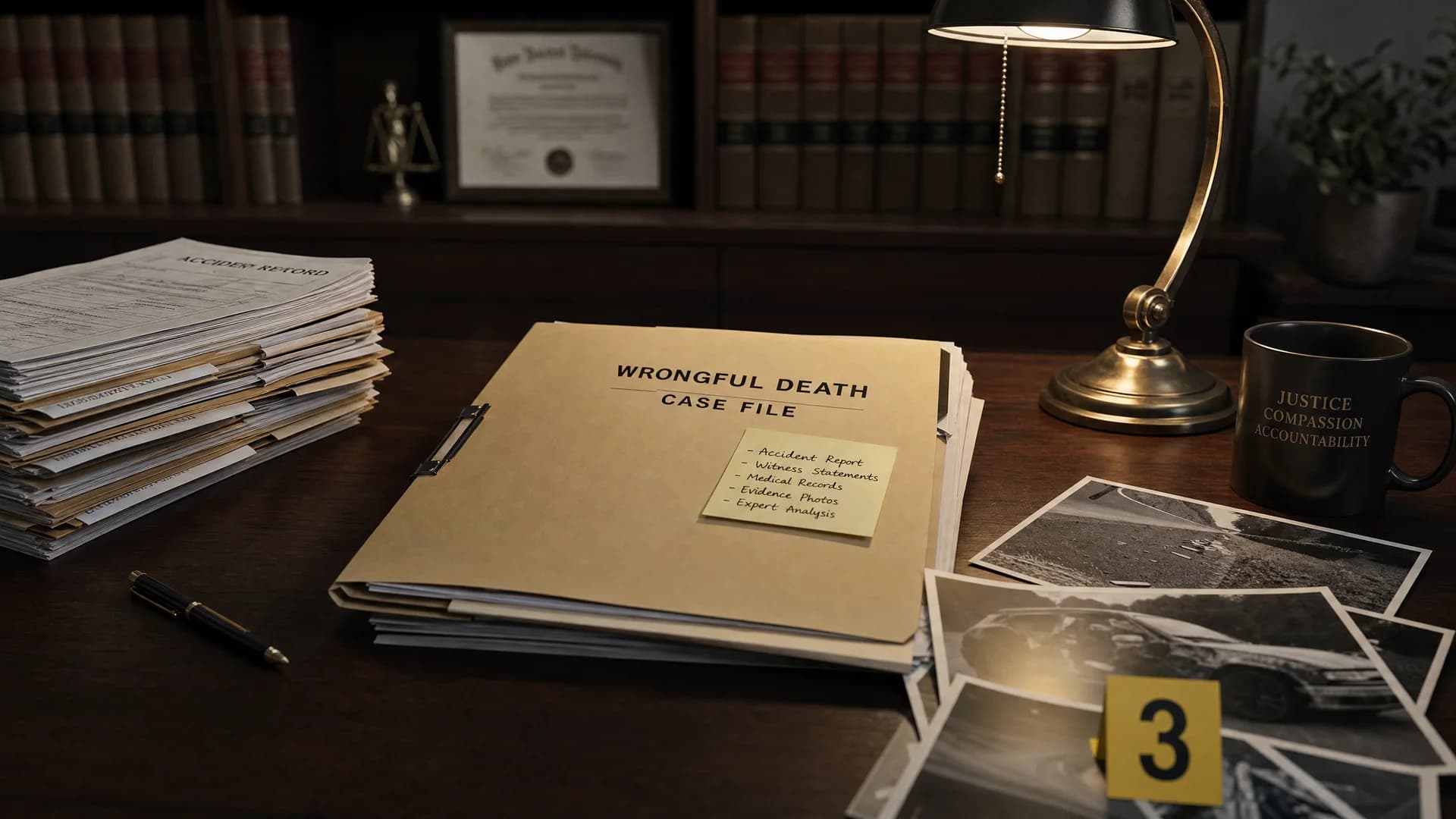
Florida sets a filing deadline for wrongful death claims, generally requiring that a wrongful death action be filed within 2 years of the date of death. That deadline is set by Fla. Stat. §95.11(5)(e), and the clock runs from the date of death, not from the date the family learns who was responsible. One meaningful exception exists: where the death resulted from an intentional tort constituting murder under s.782.04 or manslaughter under s.782.07, the action may be started at any time against a natural person. That exception does not apply to corporate defendants. Two years sounds like plenty of time. It is not. Building a wrongful death case means gathering certified death records, crash or incident reports, all medical records from the final hospitalization, toxicology results, employment and income records, and expert opinions on future earnings. Those take months to pull together. Waiting 18 months to call an attorney is a real and serious mistake, even though the deadline technically allows it. I am available seven days a week because these cases cannot wait for business hours.
What Can Families Actually Recover?
Florida splits recoverable damages between survivors and the estate under Fla. Stat. §768.21. A surviving spouse may recover lost support and services, loss of companionship and protection, and mental pain and suffering from the date of injury. Minor children under 25 may recover for lost parental companionship, instruction, and guidance, plus mental pain and suffering. If there is no surviving spouse, all children may recover those same items. Parents of a deceased minor child may recover for mental pain and suffering. Parents of a deceased adult child may recover mental pain and suffering only if no other survivors exist. The estate itself may recover the decedent's lost earnings from injury through death, loss of prospective net accumulations, and medical and funeral expenses charged against the estate. There is one Florida-specific rule that catches many families off guard. In a medical-negligence wrongful death case, Fla. Stat. §768.21(8) bars adult children from recovering non-economic damages and bars parents of an adult child from recovering as well, unless no other survivors exist. This provision is sometimes called Florida's "free kill" statute, and it remains in effect. A bill to repeal it, HB 6017, passed the legislature in 2025 but was vetoed by Governor DeSantis on May 29, 2025.
How Wrongful Death Cases Are Actually Valued
Listing the types of damages a family can recover is the easy part. What almost no one explains is how those damages actually get calculated. Economic damages in a wrongful death case are built on forensic economic analysis. A forensic economist pulls work-life expectancy tables published by the U.S. Bureau of Labor Statistics to project how many more working years the decedent had left. Lost future earnings come from documented income history, industry wage growth projections, and occupational data tied to the decedent's specific field. Household services, including childcare, cooking, home maintenance, and transportation, are valued using replacement-cost studies drawn from peer-reviewed occupational research. Those projected income streams are then discounted to present value, because a dollar paid today is worth more than a dollar paid twenty years from now. The defense will hire their own economist and pick apart every assumption in that model. I work with forensic economists who understand how Florida juries read these projections and who build models that survive cross-examination. The number that comes out of that analysis forms the floor of any negotiation. It is not a guess.
The Evidence That Disappears Fastest, and What to Do First
The first call a family makes should go to an attorney. I used to believe that without question. I was wrong about the order of operations. The attorney matters enormously, but evidence that makes or breaks a wrongful death case can vanish in 48 to 72 hours whether or not a lawyer has been hired yet. Surveillance footage from gas stations, intersections, and nearby businesses is typically overwritten on a 24 to 72-hour loop unless someone sends a legal hold notice first. Crash reports from the Florida Highway Patrol or local police are public records. Families can request them directly, no attorney required, and speed matters. Witness contact information captured at the scene, before memories fade, is irreplaceable. If the death involved a trucking company, electronic logging device data and black-box records can begin overwriting within days without a preservation demand in place. For deaths at a medical facility, request a written copy of all medical records before any transfer or discharge paperwork is finalized. This is not a strategy memo. It is a practical checklist. The attorney handles the legal hold letters, the HIPAA authorizations, and the formal document requests. But the family can start protecting evidence before that attorney relationship even begins. I walk every prospective client through this checklist on the first call, because I stay personally involved from the start.
- Probate and PR Appointment. If no personal representative has been appointed for the estate, we open a probate proceeding to get one designated. This step is non-negotiable under Fla. Stat. §768.20 and must happen before any wrongful death suit is filed. In many families, this takes 4 to 8 weeks.
- Investigation and Evidence Preservation. We send legal hold letters to all parties who control relevant evidence: trucking companies, hospitals, property owners, phone carriers. We obtain crash reports, medical records, toxicology reports, employment files, and security footage. We retain expert witnesses including forensic economists, accident reconstructionists, and medical experts depending on the case.
- Demand and Pre-Suit Negotiation. We present a formal demand package to the responsible party and their insurer. This includes liability analysis, economic loss projections, and survivor damages. Many cases resolve at this stage, particularly in rear-end crashes, trucking accidents, and premises liability deaths where liability is clear.
- Filing Suit and Discovery. If demand is rejected or the insurer low-balls the offer, we file suit in the appropriate Florida circuit court. Discovery follows: depositions of witnesses and experts, production of documents, and requests for admissions. Depositions of surviving family members are standard. I prepare every client personally for what to expect.
- Mediation and Resolution. Florida courts require mediation in most civil cases before trial. A certified mediator facilitates a structured negotiation session. Most wrongful death cases resolve at mediation. If not, the case proceeds to trial. The full process from retention to resolution typically runs 18 to 36 months in South Florida courts.
What Shrinks the Check: Liens, Subrogation, and Creditors
Most pages competing for this keyword never tell families what happens to the money after a settlement or verdict. That gap is dangerous. Medicare and Medicaid hold federal and state liens against any personal injury or wrongful death recovery where they paid for the decedent's medical treatment. Those liens must be resolved before any funds go out the door. Medicare's conditional payment process runs through the Centers for Medicare and Medicaid Services (CMS), requires written notice, and takes time. Miss it, and the government can come after the family directly. Private health insurers typically have subrogation rights written into their plan contracts. That means they are entitled to reimbursement from the recovery for amounts they paid toward the decedent's care. Medical providers who went unpaid, including hospitals and treating physicians, may hold provider liens under Florida's hospital lien statute. Estate creditors can also make claims against the estate's share of the recovery. All of this means a $1.2 million settlement does not necessarily put $1.2 million in the family's hands. I build lien resolution into the case plan from day one. It is not an afterthought when the check arrives. The Florida Department of Financial Services consumer guidance is a useful reference for understanding how insurance obligations interact with claims.
Wrongful Death vs. Survival Action: What Is the Difference?
| Factor | Wrongful Death Claim | Survival Action |
|---|---|---|
| Who owns the claim | Statutory survivors and the estate, through the PR | The decedent's own estate (continues decedent's pre-death claim) |
| When it applies | Death was caused by the injury or wrongful act | Death came from an unrelated cause after the injury occurred |
| Florida statute | Fla. Stat. §§768.16–768.26 | Fla. Stat. §46.021 (survival principle); abatement/merger §768.20 |
| Filing deadline | 2 years from date of death (§95.11(5)(e)) | Runs on the underlying claim's own limitations period (§95.11) |
| Damages recoverable | Survivors' non-economic losses, lost support, estate economic damages | Decedent's pre-death pain and suffering, medical bills, lost wages to date of death |
| Can both exist in the same case? | Yes, if death was caused by a separate unrelated event | Yes, but the decedent's PI claim abates and merges into WD if the injury caused the death |
Florida's Modified Comparative Negligence and Wrongful Death
Florida shifted from pure comparative negligence to modified comparative negligence on March 24, 2023, under HB 837 (2023). Under Fla. Stat. §768.81(6), a plaintiff found more than 50% at fault for their own harm recovers nothing. That rule reaches wrongful death claims for causes of action that accrued on or after March 24, 2023. If a decedent was found 51% or more responsible for their own death, the survivors and estate recover zero. This is the 51% bar. Defense insurers and defense attorneys push it from the moment a claim is filed. In a car crash, they argue the decedent was speeding. In a premises case, they argue the decedent was trespassing or ignored visible warnings. There is one exception. Wrongful death actions arising from Chapter 766 medical negligence remain under pure comparative fault. In a medical-malpractice wrongful death case, a claimant's percentage of fault reduces recovery proportionately but does not bar it, even above 50%. Knowing which rule applies to your case changes the entire valuation and negotiation picture. I study these arguments closely, and I build your case around the evidence before the other side can shape the story.
How Contingency Fees Work in a Florida Wrongful Death Case
Fee transparency matters. Most search results skip it entirely. I won't.
Florida's Rules Regulating the Florida Bar set presumptively reasonable contingency fee tiers for personal injury and wrongful death cases under R. Regulating Fla. Bar 4-1.5. Before the defendant files an answer or a demand for arbitration, the rate is 33⅓% of any recovery up to $1 million, 30% of the portion between $1 million and $2 million, and 20% of any amount over $2 million. Once an answer is filed and the case moves toward judgment, that first-tier rate rises to 40% of the first $1 million. The upper tiers stay the same. These are the presumptive reasonable rates. Any fee outside them requires specific court approval or written client consent with a clear explanation.
Costs are a separate conversation. Expert witness fees, filing fees, medical record retrieval costs, and deposition costs typically sit outside the contingency percentage. That distinction matters when you are deciding whether to sign a retainer. The Florida Bar's consumer guidance tells you exactly what questions to ask before you do.
I walk every client through the fee structure in plain language before we start anything. You ask, I answer directly. I handle your case personally, and you work directly with me, not a rotating cast of case managers you have never met. There is no fine print.
- Does the attorney handle probate coordination?. If no PR has been appointed, the attorney must work with a probate proceeding before the wrongful death suit can be filed. Ask directly whether they manage that process or refer it out, and who pays for it.
- Who actually works your case?. At many large firms, an intake attorney signs you up and a junior associate or paralegal handles the day-to-day. Ask the attorney who will draft your demand letter, appear at depositions, and sit across the table at mediation. You deserve a direct answer.
- How do they handle Medicare and Medicaid liens?. If the decedent was covered by Medicare or Medicaid, lien resolution is mandatory before distribution. Ask what their process is and whether they use an outside lien resolution company or handle it in-house.
- Do they work with forensic economists?. Economic damages in a wrongful death case require expert testimony to hold up at trial or in mediation. An attorney who builds the damages number on rough estimates and life expectancy charts without a forensic economist is undervaluing the claim.
- What is the realistic timeline?. Any attorney who promises a quick resolution without understanding the defendant's insurance coverage, the liability complexity, and the estate's probate posture is either guessing or telling you what you want to hear. Expect 18 to 36 months in South Florida.
Related Reading on Wrongful Death and Florida Injury Law
When a family is researching a wrongful death claim, or helping someone else do it, a few topics come up again and again in South Florida cases. Knowing how the personal representative role gets established, how Florida's comparative fault rules play out in real crash situations, and how insurers behave in the first days of a claim, all of that helps a family think clearly instead of just react. Here are the areas worth reading more about: how Florida's modified comparative negligence rules apply to fatal commercial trucking crashes; what evidence preservation looks like when a death happens in a hospital or assisted living facility; how insurance bad faith law touches a wrongful death claim when an insurer refuses a fair settlement within its own policy limits; how to challenge or replace a personal representative under Fla. Stat. §733.504 and §733.506 when the appointed PR has a conflict of interest; and what Florida's probate court process looks like when the person who died left no estate plan. These are the follow-on questions I hear most often in initial consultations. They are also the ones where solid preparation makes a real difference in what is possible.
Frequently asked questions
Who can file a wrongful death lawsuit in South Florida?
How long does a family have to file a wrongful death claim in Florida?
Can adult children recover damages in a Florida wrongful death case?
Does Florida's comparative fault rule apply to wrongful death claims?
How much does a wrongful death attorney cost in Palm Beach or Broward County?
Ready to get started?
Reach out today for a fast, no-pressure quote.
This page is for general informational purposes and is not professional, legal, or medical advice. Sean Goldstein can advise on your specific situation, contact us for a consultation. Licensed: FL Bar #1018013.