Trip and Falls in South Florida: What You Must Prove
Trip and falls in South Florida hinge on one word: notice. Learn what property owners must have known and how to protect your claim from day one.
Trip and fall cases look simple from the outside. You fell. You got hurt. The property was dangerous. That should settle it, right? It is not that simple. Florida law does not let you win just by proving a hazard was there. You have to prove what the property owner knew, when they knew it, and what they did, or failed to do, about it. That is the real fight in every trip and fall case I handle across Palm Beach, Broward, and Miami-Dade Counties. The evidence that decides those cases often vanishes within 48 to 72 hours of the fall. This page walks you through the law, the process, and what you need to do right now to protect your rights.
What Florida Law Actually Requires in a Trip and Fall
Florida premises law puts the burden squarely on the injured person in trip and fall cases involving transitory conditions on business property. Under Fla. Stat. §768.0755, you must prove the business had actual or constructive knowledge of the dangerous condition and should have fixed it before your fall. Actual knowledge means someone on staff knew the hazard was there. Constructive knowledge comes in two forms: either the hazard sat there long enough that a reasonably careful owner should have found it, or the condition happened so regularly it was foreseeable. That second path, foreseeability, is often the strongest angle when maintenance records are thin.
I want to be direct about something. §768.0755 was enacted in 2010, not by HB 837 in 2023. It reversed a prior plaintiff-friendly rule from Owens v. Publix, 802 So. 2d 315 (Fla. 2001) that made these cases significantly easier for injured people. The legislature handed that ground back to property owners. My job is to build the notice argument anyway, pulling on maintenance logs, inspection schedules, and prior incident reports to show what the business knew or should have known.
The Evidence That Disappears Fast
Surveillance video is the single most important piece of evidence in a trip and fall case. Most commercial systems overwrite footage on a 24- to 72-hour loop. The moment I take a case, I send a spoliation letter, a formal legal notice demanding the property owner preserve that footage. If they destroy it after receiving that letter, that destruction can become evidence against them at trial. Video alone does not tell the whole story, though.
Maintenance logs and inspection checklists tell me how often the property was checked and whether the hazard showed up in earlier reports. Prior incident reports from the same location carry real weight. They can show that a condition kept coming back, which goes directly to whether the owner should have known about it. I also request employee schedules to pin down who was on duty when you fell. In serious cases I photograph the area and take measurements of the exact defect. Those records build a picture no one can easily talk their way around.
An objective benchmark matters in trip and fall cases. A floor-level change of one-quarter inch or more is widely recognized as a tripping hazard, and I use that standard to show a defect was genuinely dangerous, not just an unlucky step. When a property owner's own inspection checklist, video system, and incident history all point the same direction, the facts speak for themselves. My focus is on building the strongest possible record for you from day one. I have been part of more than 350 cases and have helped recover over $26 million for injured clients (prior results do not guarantee a similar outcome), and that experience shapes how I read and pursue the evidence in every trip and fall claim.
How Comparative Fault Affects Your Trip and Fall Recovery
This is the part of the law the defense will use against you hardest. Florida adopted a modified comparative negligence standard for negligence claims accruing on or after March 24, 2023, under Fla. Stat. §768.81(6). If a jury finds you more than 50% responsible for your own fall, you recover nothing. At 50% or under, your damages drop by your share of fault. In a trip and fall, the defense typically argues you were not watching where you were going, you wore the wrong footwear, or the hazard was open and obvious. That last argument is more layered than it sounds. Under Middleton v. Don Asher & Assocs., 262 So. 3d 870 (Fla. 5th DCA 2019), an open and obvious condition may relieve a landowner of the duty to warn, but it does not automatically wipe out the separate duty to keep the premises reasonably safe. Comparative fault, not a complete bar, is the proper mechanism when a hazard was visible. I used to underestimate how fast defense teams raise the comparative fault argument in trip and fall cases. That was a mistake. Now it is one of the first things I look at when I evaluate a new case, because the answer shapes every decision about how I document the scene and frame the facts.
Trips on Public Sidewalks: Government Property Is Different
Suing a government entity after a trip and fall is a different process than suing a private business. Florida's sovereign immunity rules limit when and how that lawsuit can happen. They also require a formal written notice of claim filed with the agency before you can ever set foot in court. The agency gets a window to respond or settle. If it does nothing, you can move forward. The deadlines are tighter here. The steps are more technical than a standard premises case. I handle these claims across all three counties I serve, and the notice-of-claim requirement is not optional. Miss that step or blow the deadline and your claim can be permanently barred, no matter how clear the liability looks. If you fell on a cracked county sidewalk or inside a city-owned parking structure, call me before you speak with the municipality's risk management department. That department is not looking out for you. Once a lawsuit is filed, Florida Courts offers a plain-language overview of how civil cases move through Florida's court system.
Trip and Fall vs. Slip and Fall: What Changes in Your Case
| Factor | Trip and Fall | Slip and Fall |
|---|---|---|
| Primary cause | Foot catches a fixed or structural defect (cracked pavement, raised threshold, uneven flooring) | Loss of traction on a transitory substance (spilled liquid, wet floor) |
| Fall mechanics | Forward pitch, facial trauma, wrist fractures from bracing, knee injuries | Backward or sideways fall, tailbone, hip, and head injuries more common |
| Key legal standard | Common-law duty to maintain premises; §768.0755 may apply if substance is also present | Plaintiff must prove actual or constructive knowledge under §768.0755 |
| Critical evidence | Photos of defect dimensions, prior work orders, building inspection records | Maintenance logs, floor-check logs, surveillance showing how long substance was present |
| Defense argument | Open and obvious condition; plaintiff not watching where they were going | Spill just occurred; no reasonable time to discover and clean it |
| Medical documentation focus | Hand, wrist, face, and knee injuries; orthopedic and plastic surgery records | Hip, spine, and head injuries; neurology and orthopedic records |
What a Trip and Fall Claim Actually Looks Like
Most clients walk in with no idea what the next six to twelve months will look like. Here is the honest version.
First, I gather and preserve evidence fast. Ideally that happens within the first 24 to 48 hours of being retained. Second, you finish your medical treatment. No demand letter goes out while you are still treating. Third, I build the demand package: medical records, bills, lost wage documentation, photographs, and a liability narrative focused on the notice issue. Fourth, I send the demand to the property owner's insurance carrier. Most trip and fall cases settle at that stage. Some do not. If the insurer low-balls or denies the claim, I file suit. From filing through trial in South Florida courts, expect 12 to 24 additional months in most cases. That is not a scare tactic. It is the reality of court calendars in Palm Beach, Broward, and Miami-Dade.
The Florida Department of Financial Services publishes consumer guidance on how insurance claims work and what insurers owe claimants. Read it before your first conversation with an adjuster. My strong advice: do not talk to the property owner's insurer without an attorney. They are not gathering information to help you.
- Free consultation. Same day when possible. I take your call seven days a week. In the first conversation I assess whether notice can be proven, identify the responsible party (retailer, landlord, municipality), and flag any immediate evidence that must be preserved.
- Evidence preservation within 48 hours. I send a spoliation letter to the property owner or their insurer, demanding preservation of surveillance footage, maintenance logs, inspection records, and prior incident reports. This is the most time-sensitive step in any trip and fall case.
- Medical treatment and documentation. I work alongside your treating physicians to ensure your records connect the fall to your specific injuries. For trip and falls, wrist fractures, facial injuries, and knee injuries are common because of the forward-pitch mechanics. Gaps in treatment hurt claims.
- Demand package and negotiation. Once you reach maximum medical improvement, I build a complete demand package and present it to the carrier. I negotiate from a position of documented liability, not desperation, and I will tell you honestly when an offer is fair and when it is not.
- Litigation if necessary. If the insurer refuses a fair resolution, I file suit in the appropriate Florida court. I lead the litigation personally, from discovery through trial, with my team supporting the work behind the scenes. You are not handed off to a rotating cast of case managers, and the attorney you hire is the attorney who handles your case.
South Florida Hazards and Property Owners Who Must Answer for Them
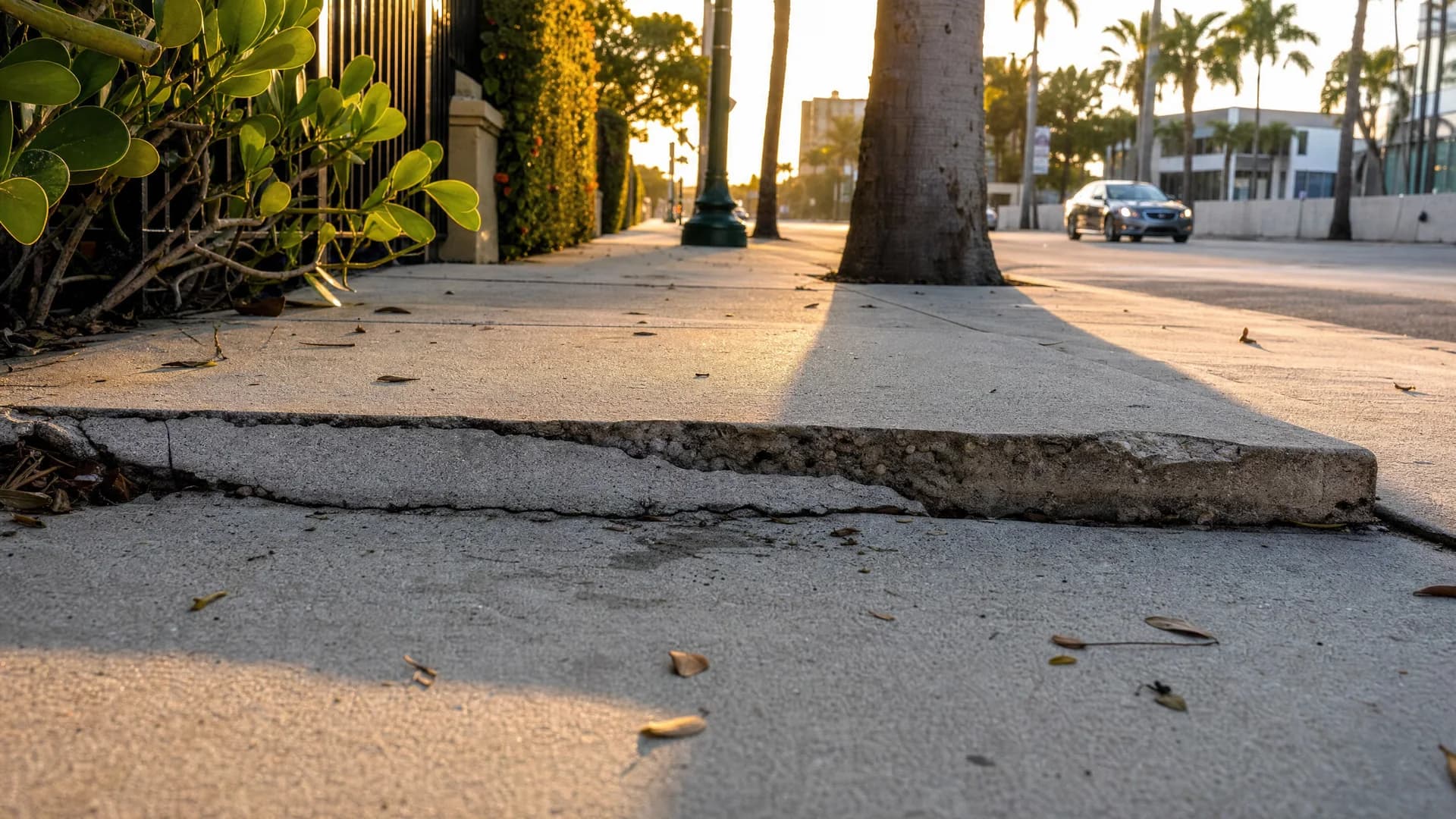
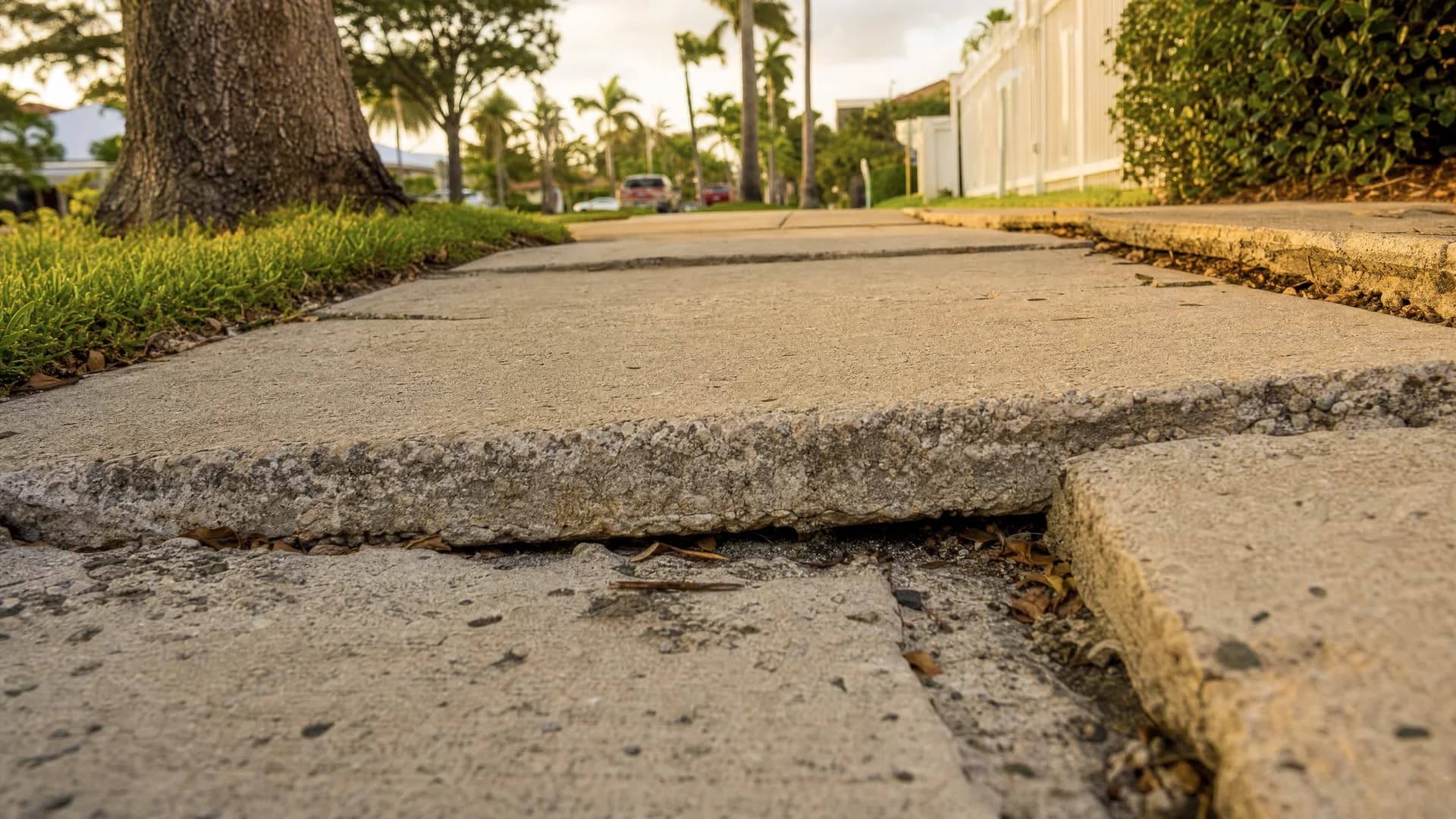
South Florida's climate produces trip and fall hazards you rarely see at the same frequency anywhere else. The wet season runs June through October. Daily afternoon rains soak outdoor walkways, parking lot transitions, and entry thresholds, turning ordinary surfaces into slip hazards. In older Palm Beach County neighborhoods, tree roots push up beneath sidewalks, lifting and cracking concrete at the joints. Those raised lips, sometimes one to three inches high, are nearly invisible to a pedestrian looking straight ahead. Retail strips across Broward and Miami-Dade sit on aging asphalt lots with significant grade changes that have gone unrepaved for years. Every one of those scenarios points to a property owner who carries a legal duty: the retailer, the landlord, the property management company, or the municipality.
Florida premises law sets the highest duty of care on owners who invite the public onto their property. A customer is an invitee. That status matters. The owner must take reasonable care to keep the premises safe, and must warn of hidden dangers the owner knows about, or should know about, but that a visitor would not reasonably find on their own. Those two duties, maintain and warn, are separate obligations. Checking one box does not excuse ignoring the other. This is the same framework that applies to slip and falls on business property. It covers trip and falls on structural defects just the same.
- Cracked or raised sidewalk joints. Tree root uplift and heat expansion cause concrete slabs to shift. A lip of one-quarter inch or more meets OSHA's tripping threshold and, combined with prior knowledge or long duration, creates a solid notice argument.
- Uneven parking lot surfaces. Aging asphalt in South Florida retail and commercial lots develops potholes and grade changes. Landlords and property management companies typically bear the duty to maintain these areas for business invitees.
- Raised door thresholds and transitions. Interior-to-exterior transitions in older strip mall units often have raised metal thresholds that were never brought up to current ADA or building code standards. A tenant's lease may shift maintenance responsibility to the landlord. That determination changes who gets sued.
- Loose or damaged floor covering. Curled carpet edges, broken tile, and warped laminate flooring inside stores, hotels, and apartment common areas are structural defects, not transitory hazards. These claims rely on common-law premises duties more than §768.0755.
- Poorly lit exterior walkways. Florida's afternoon storms knock out lighting, and many commercial properties do not restore it promptly. Darkness that obscures an existing defect builds up the property owner's liability because the duty to warn of known hazards is heightened when the defect is not visible.
My Hot Take: The Notice Argument Is Stronger Than Most Attorneys Let On
I think most trip and fall cases that get turned down by personal injury firms are rejected too fast. Here is my specific position: attorneys dismiss constructive notice claims because proving how long a hazard existed feels like guesswork. It is not guesswork when you subpoena maintenance logs and find months of deferred repairs. It is not guesswork when you pull prior incident reports and find three falls in the same location over two years. That pattern is foreseeability under §768.0755(1)(b), and it is a real path to liability. Firms reject these cases because building the notice argument takes work. I do that work. If someone told you your trip and fall case is not worth pursuing, I want to hear the facts before you accept that conclusion.
This connects directly to why I keep my practice small. When you hire Sean Goldstein, I personally review your file and lead your case, with my team supporting the work behind the scenes. I earned a Juris Doctor and a Master of Business Administration, both from Florida State University, and I have spent seven years focused on cases exactly like yours. I know how property owners and their insurers evaluate these claims, and that focus shapes how I build your case. For broader context on evaluating a personal injury attorney and understanding legal fees, The Florida Bar's consumer guidance is an honest starting point. My law firm page covers the full range of injury cases I handle across South Florida. Serious injuries from car accidents, trucking accidents, motorcycle accidents, animal attacks, child injuries, and wrongful death all follow the same principle: the attorney you hire should be the one doing the work.
Frequently asked questions
How long do I have to file a trip and fall lawsuit in South Florida?
What does 'notice' mean in a South Florida trip and fall case?
Can I still recover if I was partly at fault for my trip and fall in Florida?
What if I tripped and fell on a public sidewalk?
How is a trip and fall different from a slip and fall in Florida?
What evidence should I collect after a trip and fall in South Florida?
How much does it cost to hire a trip and fall attorney in South Florida?
Ready to get started?
Reach out today for a fast, no-pressure quote.
This page is for general informational purposes and is not professional, legal, or medical advice. Sean Goldstein can advise on your specific situation, contact us for a consultation. Licensed: FL Bar #1018013.