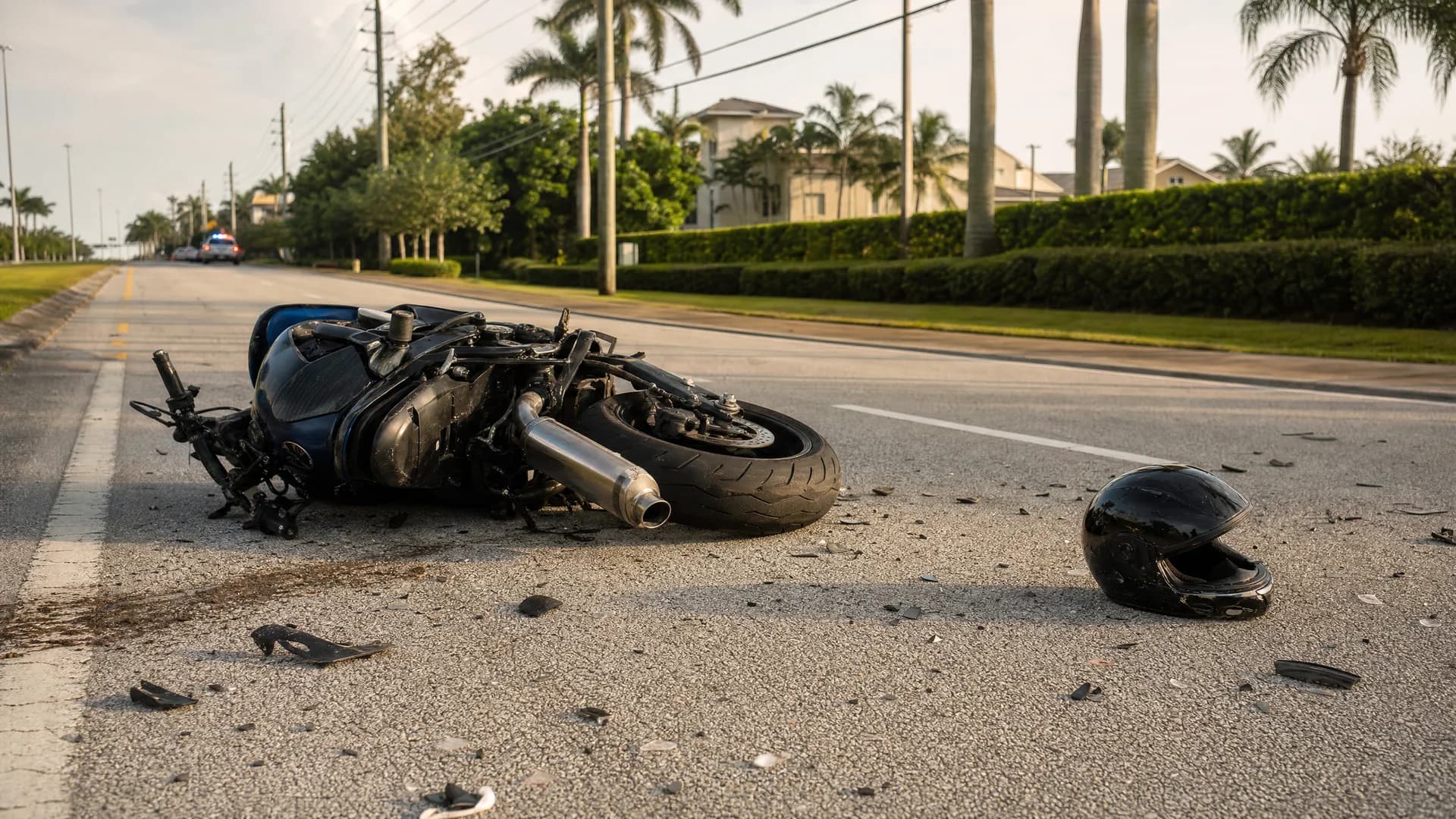
Motorcycle Accidents in South Florida
Motorcycle accidents in South Florida leave riders without PIP protection. I build your case from fault analysis to UM/UIM recovery. Free.
Everyone tells you to call your insurance company first after a motorcycle crash. That advice is wrong.
Motorcycles are fully excluded from Florida's no-fault PIP system. There is no personal injury protection claim to file. No adjuster is working for you from day one. There is no automatic medical-bill coverage while you recover.
Motorcycle accidents in South Florida follow a very different legal path than car crashes. Knowing that difference before you talk to any insurer may be the most important call you make after the wreck. I'm Sean Goldstein. I earned a Juris Doctor and a Master of Business Administration, both from Florida State University, and I am a licensed Florida personal injury attorney based in Palm Beach Gardens. I handle motorcycle accident cases across Palm Beach, Broward, and Miami-Dade counties. You can reach me directly about your case.
Why Motorcycle Accidents Play by Different Rules in Florida
Motorcycle accidents in South Florida run into a specific insurance gap. Most riders never know it exists until after a crash. Under Fla. Stat. §627.732, Florida's PIP no-fault system applies only to a "motor vehicle." That term covers self-propelled vehicles with four or more wheels. A two-wheeled motorcycle does not meet that definition. Riders neither pay for PIP nor receive it.
That exclusion cuts both ways. The tort threshold under §627.737 does not apply to you as a rider either. That rule normally forces car-crash victims to prove a "serious or permanent" injury before they can sue for pain and suffering. As a motorcyclist, you can bring a direct, fault-based negligence claim against the at-fault driver for all damages, including pain and suffering, from dollar one. That is the one legal fact every South Florida motorcyclist should know cold before they ever get on the road. The Florida Department of Financial Services has consumer guidance on insurance claims worth reading, but it will not spell out this specific detail about motorcycle riders.
Florida's Comparative Fault Rule and the 50% Bar
Florida follows modified comparative negligence under Fla. Stat. §768.81(6), enacted by HB 837 in 2023. If you are found more than 50% at fault for your own crash, you recover nothing. If you are 50% or less at fault, your damages are reduced by your share of fault.
That rule hits motorcycle cases hard. Insurers routinely argue the rider was speeding, lane-splitting, or otherwise reckless. I have seen adjusters pin 40 or 50 percent fault on a rider based solely on the driver saying they "didn't see" the motorcycle. That is a bias argument dressed up as a liability defense. I counter it with hard evidence: dispatch audio, traffic camera footage, physical measurements of skid marks and point of impact, and witness statements taken before memories fade.
In Broward County, emergency dispatch uses a Signal 4 classification for injury accidents. Those records are time-sensitive public documents, and I request them right away. The same goes for Florida Department of Transportation traffic camera footage along corridors like I-95 or US-1 in Palm Beach and Miami-Dade. That footage is typically overwritten within 30 to 72 hours if no preservation request is made.
Helmet Laws, Eye Protection, and Comparative Fault
Florida's helmet law, Fla. Stat. §316.211, requires every motorcycle operator and passenger to wear a helmet meeting Federal Motorcycle Vehicle Safety Standard 218. There is one key exemption. A rider over 21 who carries at least $10,000 in medical coverage may legally ride without a helmet under §316.211(3)(b). Eye protection under §316.211(2) is still required for operators regardless of that exemption.
Here is the part most South Florida attorneys won't say out loud. Even if you rode without a helmet lawfully, a defense attorney will argue at trial that your head or neck injuries were made worse by that choice. The statute does not create automatic civil liability for helmet non-use. Lawful use of the exemption does not bar your claim. But it does become a comparative fault argument, and those arguments shift the numbers.
I raise this at the first consultation. My clients know exactly what they are facing before discovery closes, not after. The Florida Bar's consumer information page explains what to look for when hiring a personal injury attorney. The attorney-client candor it describes is something I take seriously from day one. You hired me. I handle your case, and I give you the honest picture up front.
- Fault Investigation. I reconstruct the crash using dispatch records, physical evidence, and witness statements to counter insurer arguments that the rider was partially or fully at fault under §768.81.
- Insurance Coverage Analysis. Because motorcycles carry no PIP, I identify every available source of recovery: the at-fault driver's bodily injury liability policy, your own UM/UIM coverage, MedPay, and any third-party policies.
- Injury Documentation. Road rash, traumatic brain injury, spinal fractures, and soft-tissue damage each require specific medical documentation strategies. How injuries are documented early affects what the claim is worth later.
- Dangerous Instrumentality Claims. If the at-fault vehicle was owned by someone other than the driver, Florida's dangerous instrumentality doctrine may let me pursue the owner directly for damages under §324.021.
- UM/UIM Coverage Pursuit. Florida has one of the highest rates of uninsured drivers in the country. Your own uninsured/underinsured motorist coverage under Fla. Stat. §627.727 is often the key recovery source in a motorcycle accident case.
UM/UIM Coverage: The Most Overlooked Tool in a Rider's Arsenal
Florida does not require private passenger vehicle owners to carry bodily injury liability coverage. Most riders never learn that until they're lying in a hospital bed and a claims adjuster explains the other driver carried the state minimum with zero BI. At that point, UM/UIM coverage on the rider's own motorcycle policy becomes the main source of recovery.
Under Fla. Stat. §627.727, UM coverage must be offered to any policyholder who carries primary bodily injury liability coverage. A rejection of UM, or a reduction to lower limits, must be in writing on an approved form. If a rider never signed that written rejection, the policy may default to stacking UM at the BI limits, covering the insured regardless of which vehicle they were riding. I pull that paperwork in every motorcycle case I handle. It surfaces things a quick phone call to the insurance company will never catch.
This is also why I tell every rider I speak with: before you buy a motorcycle policy, call an attorney and ask what UM/UIM you actually need, not what the minimum is. Other personal injury work I handle, including car accidents and trucking accidents, carries its own insurance complexity. But the UM gap in motorcycle cases sits in a category by itself.
- Preserve Evidence Immediately. I send preservation letters to relevant agencies within hours of being retained, requesting dispatch audio, traffic camera footage, and incident reports before they are overwritten or purged. This step cannot wait days.
- Document All Injuries and Treatment. Every gap in medical treatment becomes a weapon for the insurer. I work with clients to ensure consistent treatment documentation from the emergency room through any specialist care. Road rash, TBI symptoms, and orthopedic injuries each require specific records.
- Identify Every Insurance Layer. I pull the at-fault driver's policy, check the vehicle owner's liability if different from the driver, and audit the client's own UM/UIM and MedPay coverage. This step often reveals recovery sources that the insurer never volunteers.
- Build and Send a Demand Package. Once treatment is at maximum medical improvement (MMI), I compile a demand package with all medical records, bills, lost-wage documentation, and a liability analysis. This is the foundation for negotiation or litigation.
- Negotiate or File Suit. Most cases resolve through negotiation. When an insurer refuses a fair offer, I file suit. Under Fla. Stat. §95.11(5)(a), a negligence claim accruing on or after March 24, 2023 must be filed within 2 years. I track every deadline and never let the clock run.

Motorcycle Accident Claims vs. Car Accident Claims in Florida
| Factor | Motorcycle Accident Claim | Car Accident Claim |
|---|---|---|
| PIP Coverage | None, motorcycles excluded under §627.732(3) | Up to $10,000 PIP from own insurer under §627.736 |
| Tort Threshold | No threshold, rider may sue for pain and suffering from dollar one | Must meet 'permanent injury' threshold under §627.737 to recover pain and suffering |
| Immediate Medical Coverage | Health insurance, MedPay, or UM/UIM, no automatic PIP | PIP pays 80% of reasonable medical expenses up to $10,000 |
| Fault Standard | Modified comparative fault, >50% bars recovery (§768.81(6)) | Modified comparative fault, same standard applies |
| Insurer Bias Risk | High, jurors and adjusters often presume rider was reckless | Lower, no presumption of recklessness against driver |
| Filing Deadline (post 3/24/23) | 2 years from date of crash, §95.11(5)(a) | 2 years from date of crash, §95.11(5)(a) |
Anti-Motorcyclist Bias Is Real. Here's How I Counter It.
I'll be honest about something I got wrong early on. I assumed a clearly sympathetic injury would carry the day by itself. It doesn't. In motorcycle cases, the bias against riders runs deep. It shows up in the first adjuster call, in the initial liability evaluation, and eventually in the jury pool. Insurers count on the perception that motorcyclists are risk-takers.
The answer to that bias is not a better opening statement. It's a better investigation. I build motorcycle cases around objective physical evidence: crash reconstruction data, road surface measurements, posted speed limits against actual traffic conditions, and camera angles that show exactly where the other driver was looking.
I also look hard at the other driver's phone records. Distracted driving is a leading cause of motorcycle accidents at South Florida intersections. A subpoena for cell data at the moment of impact often tells a story no witness account ever could. If you're dealing with a fatality crash, read my wrongful death page. Those same investigative principles apply there, with even higher stakes. If a commercial truck was involved, my trucking accidents page covers the additional federal regulatory layers that come with those cases.
What Motorcycle Accident Injuries Mean for Claim Value
Motorcycle accidents create injury patterns tied directly to the absence of a cab around the rider. Road rash can look minor on the surface while hiding deep tissue damage that needs skin grafting and long-term scarring treatment. Traumatic brain injury can happen even with a helmet if the impact force is strong enough. Emergency rooms focused on acute bleeding often miss or under-document the neurological picture.
Spinal fractures at the thoracic or lumbar level are common when a rider hits asphalt. They carry permanent-impairment consequences that touch every part of the damages calculation. How those injuries get documented from day one shapes what a claim can realistically support. One ER note reading "head laceration" does not capture a TBI.
I work with clients to connect them with the right specialists. I do not direct medical care, but I know which records matter and how gaps in treatment history get turned against injured riders. Crashes that also involve other road users, dog attacks near roadways, or dangerous property conditions may connect to my slip and falls, trip and falls, or animal attacks practice areas. Child passengers hurt in motorcycle crashes fall under my child injuries practice as well.
Related Reading: Motorcycle Accident Topics
Digging into specific parts of a motorcycle accident claim puts you in a stronger position before you talk to anyone. A few topics are worth reading: how to preserve evidence after a South Florida crash before it disappears, what uninsured motorist coverage actually pays for in a motorcycle case, how Florida's modified comparative fault rule works for injury claims, the role of the dangerous instrumentality doctrine when the at-fault driver does not own the vehicle, and what a demand package looks like and why timing matters.
These topics connect directly to the broader law firm practice and the same analytical framework I bring to car accidents and every other personal injury case. The Florida Courts website is also a useful reference if your case goes to litigation and you want to understand how a civil lawsuit moves through the state court system.
Frequently asked questions
Are motorcycles covered by Florida PIP insurance?
How long do I have to file a motorcycle accident claim in Florida?
Can I still recover damages if I wasn't wearing a helmet?
What if the at-fault driver has no insurance?
What if I was partially at fault for the crash?
Ready to get started?
Reach out today for a fast, no-pressure quote.
This page is for general informational purposes and is not professional, legal, or medical advice. Sean Goldstein can advise on your specific situation, contact us for a consultation. Licensed: FL Bar #1018013.