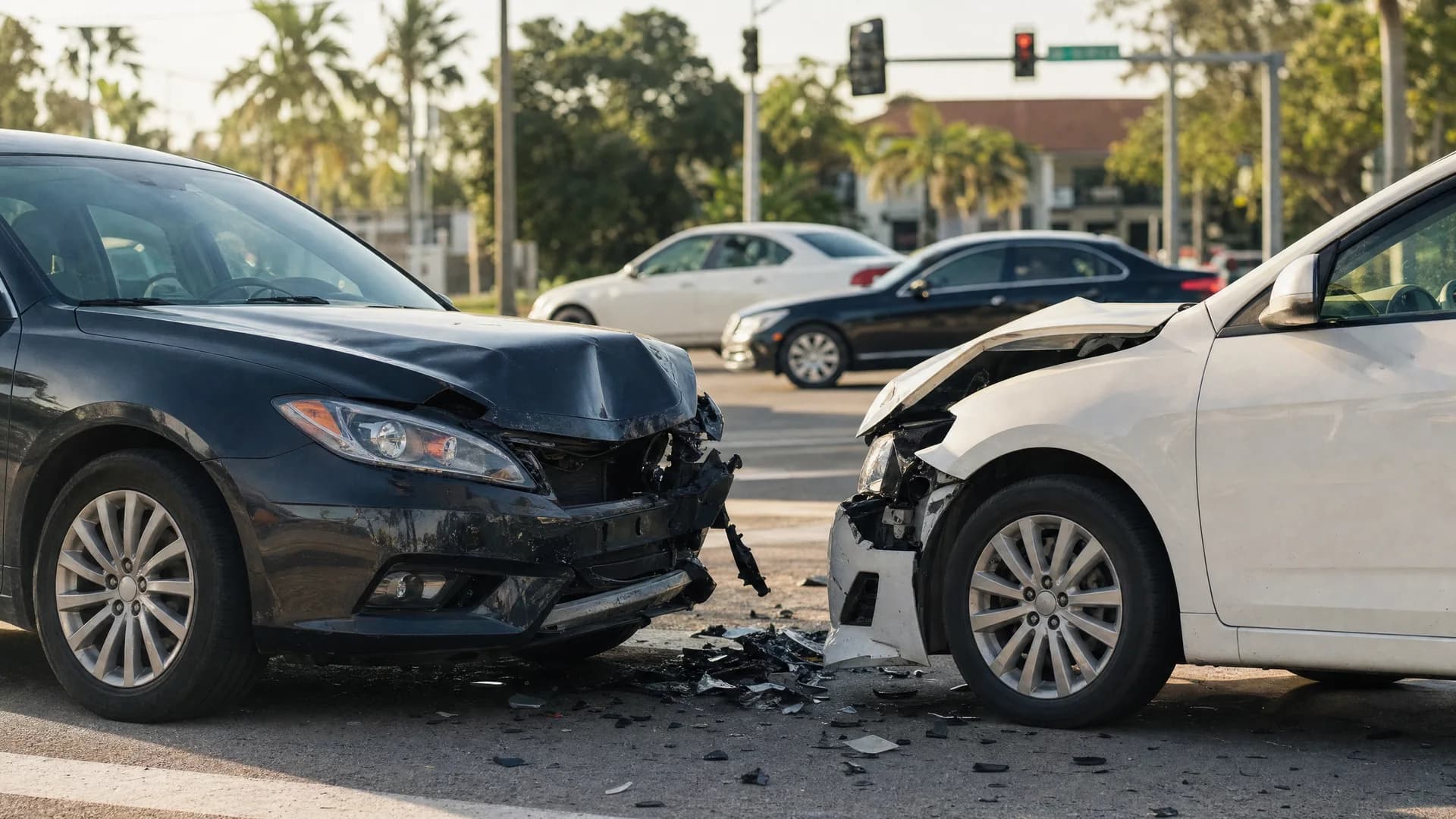
Car Accidents in South Florida: What to Do, What's at Stake
Car accidents in South Florida carry strict deadlines and insurance traps. Get a free consultation with a licensed FL injury attorney. 7 days a week.
Car accident victims in South Florida face a two-year window from the crash date to file a personal injury claim under Florida law. The first 14 days after impact also determine whether your PIP (no-fault) coverage pays anything at all. That window is not a formality. Miss it and you could lose your PIP benefits, lose key evidence, and hand the insurance company a story that is very hard to undo.
This guide walks through the exact steps, Florida-specific deadlines, and legal rules that shape whether a crash victim recovers fully or walks away short. I handle car accidents across Broward, Palm Beach, and Miami-Dade counties, and you can reach me directly about your case. You work directly with me, not a call center or an intake mill, and my team supports the case behind the scenes.
What Does Florida Law Actually Require After a Car Accident?
Florida law requires you to report a car accident to local police, the county sheriff, or the Florida Highway Patrol when the crash causes injury, death, or at least $500 in property damage. That threshold covers almost every serious collision you are likely to face.
If an officer never responds and no report gets filed, you have 10 days to submit a written self-report to FLHSMV using Form 90011s. Skipping that step is a noncriminal traffic infraction. More importantly, it leaves a hole in the official record. The other driver's insurer will notice that gap, and they will use it.
The crash report itself stays confidential for 60 days after filing. During that window, named parties, their legal representatives, and licensed insurers can still request it. Once those 60 days pass, the report becomes public record.
Here is something most people do not know going in. The report and any statements you made to the responding officer are protected by the accident-report privilege. In a standard injury case, that protection generally holds and bars those statements from being used as evidence against you at a civil trial. The privilege does carry specific criminal-trial exceptions, but that is a separate concern from the typical injury claim.
How Florida's No-Fault PIP System Shapes Your Recovery
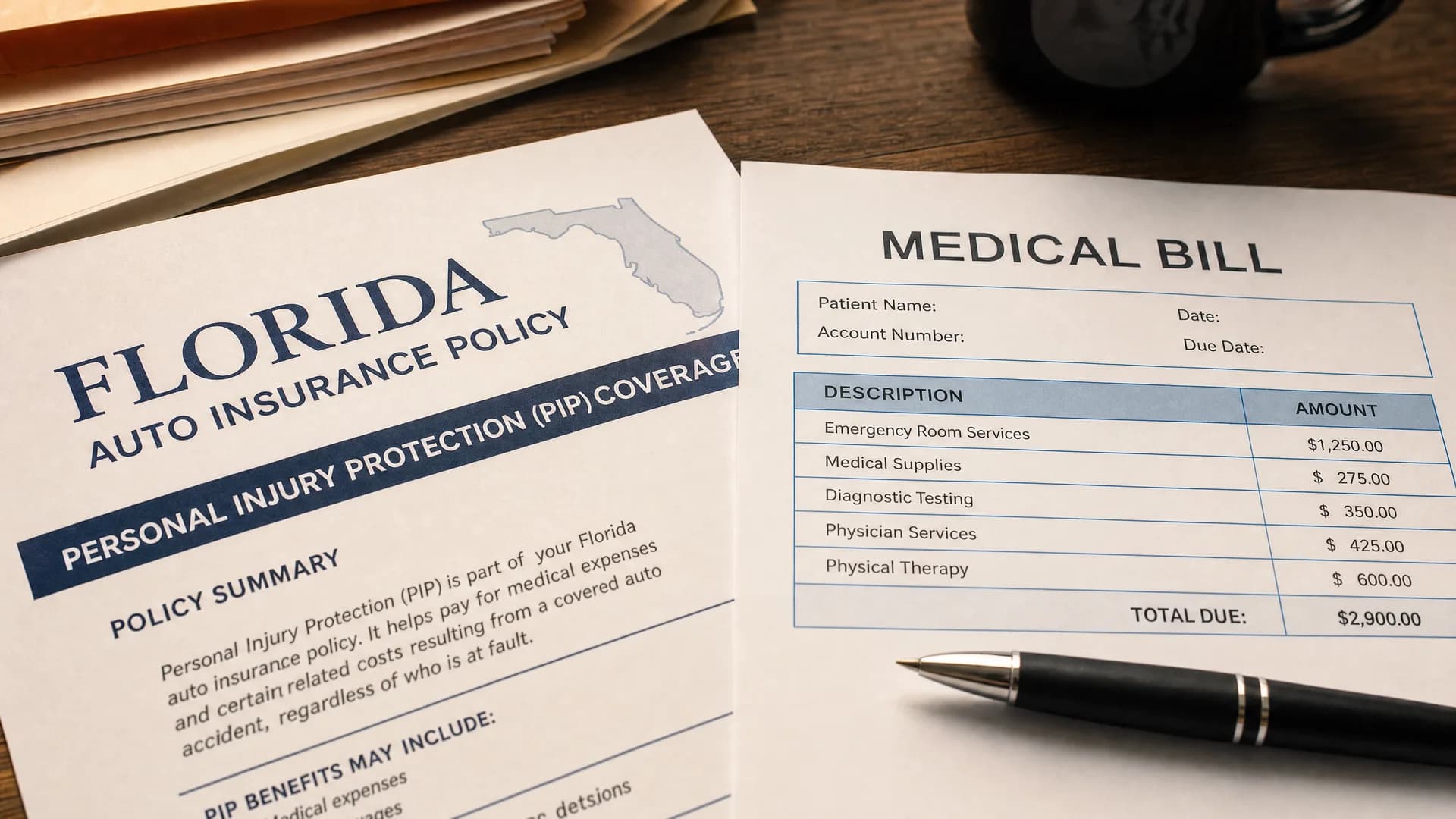
Florida is a no-fault state. Every registered vehicle must carry at least $10,000 in Personal Injury Protection (PIP) coverage. PIP pays 80% of reasonable and medically necessary medical expenses and 60% of lost gross income, up to that $10,000 limit, no matter who caused the crash.
That sounds straightforward. It is not. If a qualifying provider, such as a physician, dentist, physician assistant, or advanced practice registered nurse, finds that your injury is NOT an emergency medical condition (EMC), your PIP medical benefits are capped at $2,500 instead of the full $10,000. That EMC determination happens early. It can quietly cut your available coverage before you even realize it.
PIP does not pay for pain and suffering. It does not cover the 20% of medical bills it excludes. It also does not cover non-emergency care above $2,500 if you miss the EMC designation. For serious crashes, PIP is a floor, not a ceiling.
To recover noneconomic damages, including pain, suffering, mental anguish, and inconvenience, your injury must meet the tort threshold under Fla. Stat. §627.737(2). That means a significant and permanent loss of a bodily function, a permanent injury within reasonable medical probability, significant and permanent scarring or disfigurement, or death.
- Call 911 Immediately. Florida law requires you to notify law enforcement whenever a crash causes injury, death, or apparent property damage of at least $500. Do not assume the other driver will handle it. Get an officer on scene and an official report started. That report is the foundation of your claim.
- Document Everything You Can. Photograph all vehicles, the point of impact, skid marks, traffic signals, and any visible injuries before anything moves. Exchange full insurance information, driver's license numbers, and contact details with every driver involved. Get names and phone numbers from any witnesses while they are still present.
- Seek Medical Care Within 14 Days. This is not optional if you want PIP benefits. Go to an emergency room, urgent care, your primary physician, or any qualified provider. Tell them you were in a car accident. Get the visit documented. The 14-day window runs from the crash date and has no exceptions under Florida law.
- Notify Your Insurer, Carefully. You are required to report the crash to your own insurance company. Give basic facts. Do not give a recorded statement to the other driver's insurer before speaking with an attorney. Anything you say can be used to reduce or deny your claim. The Florida Department of Financial Services has consumer guidance on your rights when dealing with adjusters.
- Preserve Evidence and Contact an Attorney. Do not repair or sell your vehicle before your claim is resolved. Save all medical records, bills, and correspondence. Contact a licensed Florida personal injury attorney as early as possible. Evidence degrades, witnesses disappear, and the two-year statute of limitations under Fla. Stat. §95.11(5)(a) is not the only deadline that matters. Preservation letters, spoliation notices, and early investigation make a measurable difference in outcomes.
Florida's Fault Rules: How Partial Blame Affects Your Claim
Since March 24, 2023, Florida uses modified comparative negligence for car accident claims. If a fact-finder decides you were more than 50% at fault for the crash, you recover nothing, regardless of what the other driver did. If your share of fault is 50% or less, your damages drop by that percentage. At 30% fault on a $100,000 case, you recover $70,000.
This is a sharp break from the old pure comparative system, where a plaintiff could recover even at 99% fault. I want to be direct about something: the insurance industry pushed hard for this change, and adjusters are using it. Fault arguments that once played a supporting role now lead the conversation from the very first call.
If the other driver ran a red light but you were also speeding, that fact goes straight to the front of any negotiation. Start documenting your speed, your route, and your driving conditions on day one. A dashcam recording, a witness statement, or a traffic camera can flip a disputed-fault case entirely. The rule is codified at Fla. Stat. §768.81(6).
Uninsured and Underinsured Motorist Coverage: The Protection Most People Waive
Florida requires only $10,000 in PIP and $10,000 in property damage liability (PDL) to register a vehicle. Bodily injury liability coverage is not mandatory for most drivers under Fla. Stat. §324.022. That means the driver who rear-ended you at 60 mph on I-95 may carry zero coverage for your injuries.
Your Uninsured/Underinsured Motorist (UM/UIM) coverage steps in when the at-fault driver has no bodily injury coverage, or not enough to cover what you lost. Under Fla. Stat. §627.727(1), insurers must offer UM/UIM coverage equal to your bodily injury liability limits. Stacked coverage pools limits across multiple vehicles on the policy. It is the default unless you signed a written rejection form.
I underestimated early on how often clients had unknowingly waived UM coverage. They signed a form they never read at the dealership, or they dropped to lower limits to save $15 a month. I go over UM coverage in every initial consultation now. It is often the only real source of recovery when the at-fault driver is broke or uninsured. Pull your declarations page before you are in a crash, not after.
Handling Your Own Claim vs. Hiring a Car Accident Attorney
| Factor | Going It Alone | With Sean Goldstein |
|---|---|---|
| PIP Deadline Knowledge | Easy to miss the 14-day window; no one tells you | Client counseled on day one; deadline tracked |
| Crash Report Access | May not know how to request report during 60-day window | Report requested immediately; privilege issues flagged |
| Fault Disputes | Adjuster's fault assignment goes unchallenged | Evidence gathered early to counter shared-fault arguments |
| UM/UIM Coverage Review | Often overlooked; waiver forms buried in policy | Declarations page reviewed at first consultation |
| Noneconomic Damages | Pain and suffering rarely quantified or claimed | Threshold analysis done; noneconomic damages pursued |
| Attorney Fee Structure | No fee, but typically lower or no recovery | Contingency fee; you pay only if there is a recovery |
| Availability | You handle calls, paperwork, deadlines solo | Available 7 days a week; you reach Sean directly |
How Contingency Fees Work in Florida Car Accident Cases
Under the Rules Regulating the Florida Bar, the standard contingency fee for a car accident case is 33 1/3% of any recovery up to $1 million if the case resolves before the defendant files an answer or demands arbitration. Once an answer is filed, that first-tier rate rises to 40% of recovery up to $1 million.
The percentage steps down for recovery above $1 million. It drops to 30% of the portion between $1 million and $2 million, and 20% of any portion above $2 million. Those tiers apply at both the pre-answer and post-answer stages.
You pay no attorney's fee unless there is a recovery. That is what contingency representation means. What clients sometimes miss is that costs are a separate item. Deposition transcripts, expert fees, filing fees, and investigation costs are typically advanced by my firm and repaid from the recovery. I walk through that structure at the free consultation so nothing comes as a surprise later.
The Florida Bar's consumer guidance covers your rights in the attorney-client relationship in plain language. I'd encourage you to read it before we talk.

- Crash Report Retrieval and Analysis. I obtain the official crash report as quickly as allowed under the 60-day confidentiality window, then review it for errors in the officer's fault notation that can be corrected early.
- PIP and Insurance Coverage Audit. I review every relevant policy, your PIP, BI liability, UM/UIM, and the at-fault driver's coverage, before any demand is sent. Overlooked UM/UIM coverage is real money left unclaimed.
- Evidence Preservation and Investigation. Preservation letters go to potential defendants, property owners, and insurers within days of retention. Dashcam footage, traffic camera records, and cell phone data are time-sensitive. Once they are gone, they are gone.
- Medical Coordination and Documentation. I help clients understand their treatment options and ensure every visit, diagnosis, and referral is documented in a way that supports the injury claim. Gaps in treatment records are used against you.
- Negotiation and Litigation. Most cases resolve before trial. I negotiate with full litigation readiness. Adjusters offer more when they believe you will actually file suit. If a fair settlement is not available, I file and try the case. The attorney you hire is the attorney who handles your case, start to finish.
Serious and Catastrophic Injuries in South Florida Crashes
Not every car accident case carries the same weight or complexity. A rear-end collision at low speed with soft-tissue injuries follows a fairly predictable path. A high-speed crash on I-595 that causes a spinal cord injury, traumatic brain injury, or amputation is a different matter entirely.
Cases like that need life-care planners, vocational economists, treating specialists, and sometimes biomechanical engineers to fully measure what was lost. I handle catastrophic injuries alongside standard car accident cases, and the preparation looks different from day one.
When a crash involves a commercial vehicle, the complexity grows further. Trucking accidents bring in federal hours-of-service rules, electronic logging device data, and driver qualification file requirements that simply do not apply in a standard two-car collision.
I also handle motorcycle accidents, Uber/Lyft accidents, and other road-use collisions across South Florida. Beyond road injuries, my law firm practice covers slip and falls, trip and falls, animal attacks, child injuries, and wrongful death cases. If a crash killed a family member, the wrongful death statute of limitations is also two years under Fla. Stat. §95.11(5)(e). The clock is the same, but the procedural path is not.
Why Urban South Florida Crashes Are More Legally Complex
Florida Highway Patrol does not typically respond to crashes inside incorporated city limits. A collision on Las Olas Boulevard in Fort Lauderdale is likely handled by Fort Lauderdale PD, not FHP. A crash in Boca Raton goes to BRPD. This matters because each agency runs its own records system, its own crash report format, and its own evidence retention schedule.
When people search for their crash on the FHP live map and come up empty, that is why. It does not mean the crash was not reported. It means a different agency holds the record. The 60-day confidentiality window and the right to access the report as a named party still apply regardless of which agency filed it.
South Florida's traffic density, construction zones, distracted driving rates, and rain events during the wet season, June through October, all create crash patterns specific to this region. A crash at the I-95 and Ives Dairy Road interchange during a summer afternoon storm involves different visibility, road conditions, and comparative fault dynamics than a dry-day collision on a two-lane suburban road. I know these roads. My investigation approach reflects that local knowledge, not a generic national template.
Frequently asked questions
How long do I have to file a car accident lawsuit in South Florida?
What is the 14-day rule for car accident injuries in South Florida?
Does PIP insurance cover all my medical bills after a crash?
What happens if I was partially at fault for my car accident in South Florida?
How do I obtain my crash report after a car accident?
What can I do if the driver who hit me had no insurance?
Does hiring a car accident attorney in South Florida cost money upfront?
Ready to get started?
Reach out today for a fast, no-pressure quote.
This page is for general informational purposes and is not professional, legal, or medical advice. Sean Goldstein can advise on your specific situation, contact us for a consultation. Licensed: FL Bar #1018013.