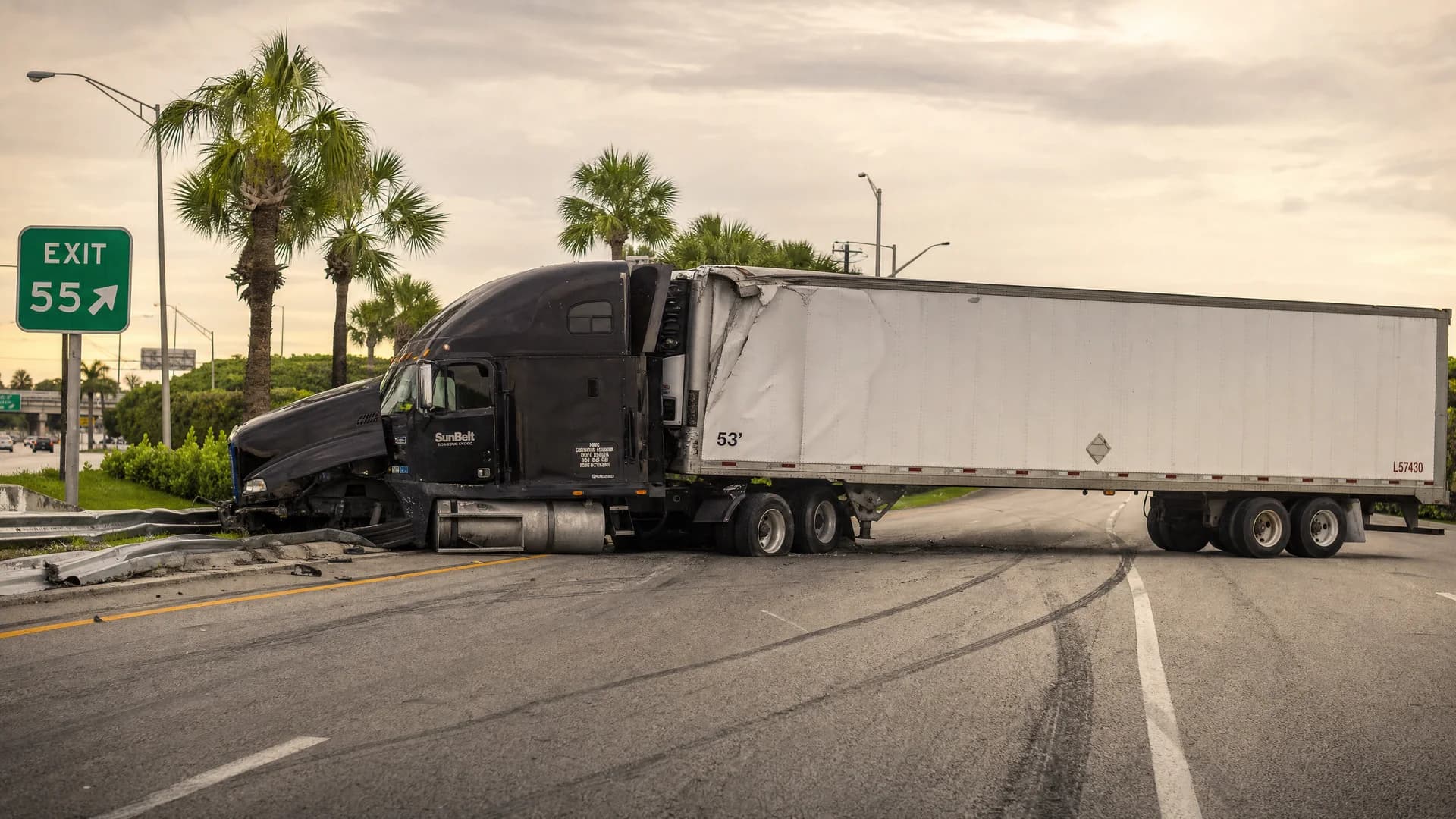
Trucking Accidents in South Florida
Trucking accidents in South Florida involve federal regulations, multi-party liability, and a closing evidence window. I know how to build these.
Large commercial trucks make up about 10% of registered vehicles in Florida. Yet they show up in a far greater share of fatal crashes on corridors like I-95 and the Florida Turnpike, the two busiest commercial freight routes in South Florida. That gap exists for a reason. Trucking accidents are not car accidents. They involve heavier vehicles, federal safety rules, multiple parties who may each share fault, and evidence that starts disappearing within 72 hours of a crash. I handle trucking accident cases across Palm Beach, Broward, and Miami-Dade counties. My job on Day 1 is not to add up your damages. My job is to stop evidence from being destroyed and to identify every party who shares responsibility for what happened to you.
Why Trucking Accidents Are Legally Different from Car Crashes
A trucking accident claim in South Florida sits at the crossroads of Florida tort law and a detailed set of federal regulations enforced by the Federal Motor Carrier Safety Administration (FMCSA). Under 49 CFR § 387.9, a for-hire motor carrier hauling general freight in interstate commerce must carry at least $750,000 in liability coverage. That minimum rises to $1,000,000 or $5,000,000 for certain hazardous materials shipments. Compare that to Florida's $10,000 property damage minimum for personal auto. The insurance math alone reshapes settlement strategy completely.
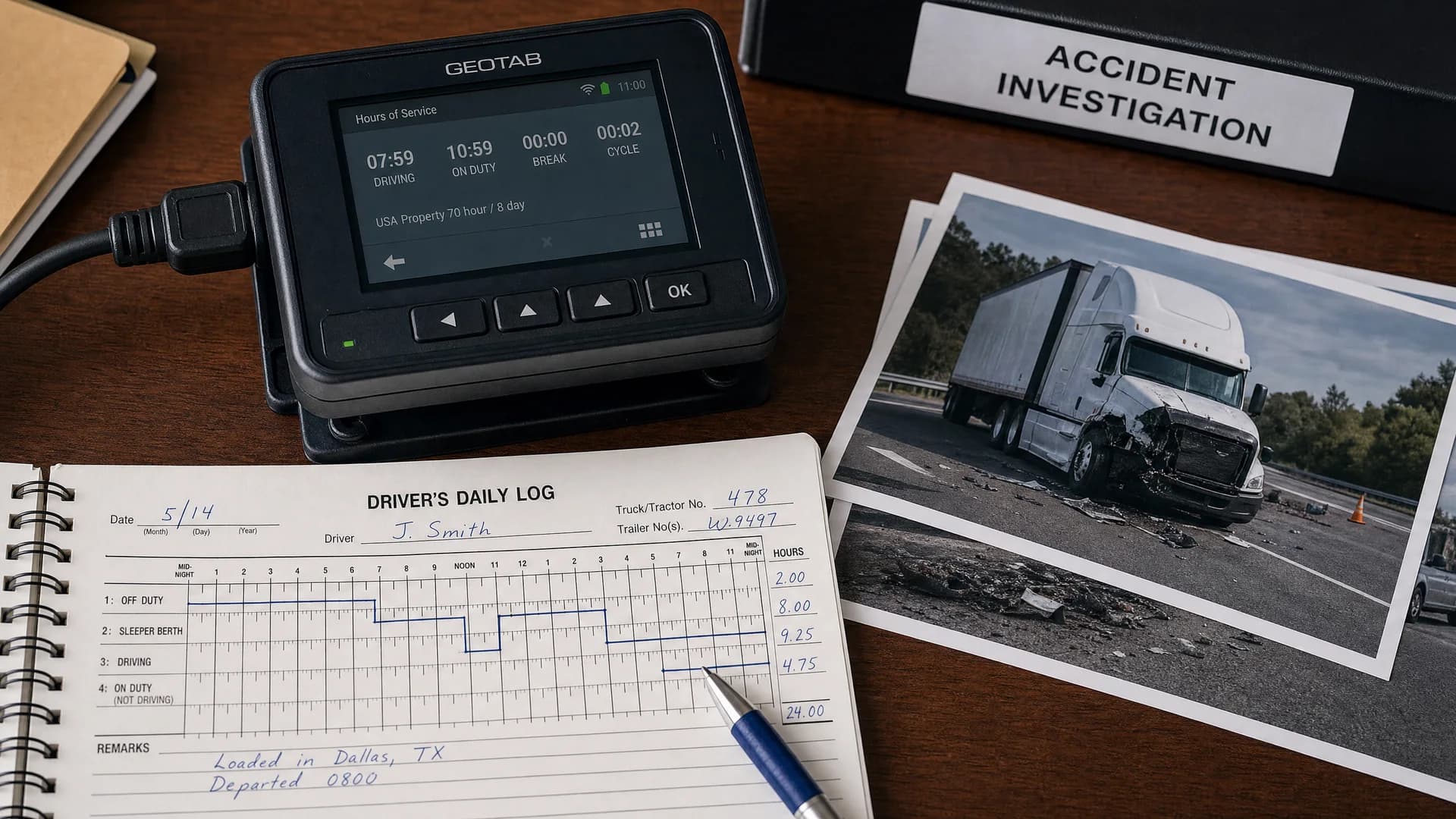
Beyond insurance, the federal Hours of Service rules under 49 CFR § 395.3 cap a property-carrying driver at 11 hours of driving after 10 consecutive hours off duty. That driving must fall within a 14-consecutive-hour on-duty window. A 30-minute rest break is also required after 8 cumulative hours of driving. Violations of these rules are a liability theory on their own. I pull the driver's logs and electronic logging device data in every trucking case I handle, because the violations are often hiding right there in the paperwork.
Who Is Actually Liable in a Trucking Accident?
Most crash victims focus on the truck driver. That makes sense. It is also often incomplete. Florida's dangerous instrumentality doctrine holds that a vehicle owner who allows another person to operate that vehicle is vicariously liable for that driver's negligence, without any proof the owner was personally at fault. Under Fla. Stat. § 324.021, the statutory cap on owner liability that protects individual car owners does NOT apply to commercial motor carrier owners. The company that owns the truck faces full exposure.
Beyond vicarious liability, I look hard at the carrier's own direct negligence. Did they hire a driver with a known unsafe record? That is negligent hiring. Did they keep a driver on the road after red flags appeared? That is negligent retention. Did they skip required pre-trip inspections? That points to negligent maintenance. If a third-party shipper improperly loaded the cargo and that load shifted before impact, the shipper enters the liability picture too. A refrigerated trailer carrier presents different physics, and potentially a different set of defendants, than a flatbed hauling construction materials. I map every responsible party before I file anything.
FMCSA Regulations That Become Evidence
Federal regulations create a paper trail that a standard car accident never generates. Every interstate commercial motor vehicle driver must maintain Records of Duty Status using a compliant Electronic Logging Device. The ELD rule lives under 49 CFR Part 395. Those records must be kept for at least six months under 49 CFR § 395.8(k)(1). That retention period is a floor, not a green light to shred files once six months pass, especially when litigation is on the horizon. I send my spoliation letter before the carrier's legal team has had time to read their own retention policy.
The driver's CDL medical certificate, Form MCSA-5875, is another document I request early. A driver who was medically unfit to operate a commercial vehicle at the time of your crash raises real questions about how the carrier hires and supervises its people. North American Standard Level I roadside inspections produce federal out-of-service records. If a truck had brake defects, tire violations, or lighting failures that should have taken it off the road, those records exist. I want them.
- ELD / Driver Log Data. Electronic logging devices record speed, location, braking events, and hours driven. This data can be overwritten quickly. My evidence-hold letter targets the carrier, driver, and any third-party fleet management system the carrier uses.
- Engine Control Module (ECM) Snapshot. The truck's ECM captures pre-crash speed, throttle position, brake application, and seat-belt status in the seconds before impact. I work with accident reconstruction experts who can pull and interpret this data before it's lost.
- Dashcam and Exterior Camera Footage. Many commercial trucks run forward-facing and cab-interior cameras. Footage is often stored on a rolling 48-72 hour loop. Timely preservation demand is essential. I do not wait for a lawsuit to be filed.
- Driver's Hours-of-Service Records. I compare the ELD log against fuel receipts, weigh-station records, and toll data. Discrepancies between the official log and the paper trail are a powerful indicator of HOS violations under 49 CFR § 395.3.
- Pre-Trip Inspection Reports. Federal rules require drivers to inspect the vehicle before each trip and report defects. I request every inspection report for the 30 days before the crash, along with maintenance logs showing how defects were resolved.
- Carrier Safety Rating and Compliance History. The FMCSA's Safety Measurement System (SMS) publishes carrier violation histories. A carrier with a pattern of HOS, brake, or driver-fitness violations before your crash has a systemic safety problem, not just a one-time mistake.
South Florida Roads Where Trucking Crashes Concentrate
I-95 through Broward and Miami-Dade is one of the most heavily traveled commercial freight corridors in the southeastern United States. The merge zones near I-595 in Fort Lauderdale, the express lane transitions near Boca Raton, and the dense interchange geometry around Miami's I-195 split all push the limits of a 65-foot tractor-trailer's maneuverability. The Florida Turnpike through Palm Beach County carries heavy overnight freight traffic. Drivers pushing through West Palm Beach or Boynton Beach between 2 a.m. and 5 a.m. are often near the end of a legal or near-legal driving window. That is exactly where HOS fatigue cases are born.
Alligator Alley, I-75 cutting through the Everglades between Broward and Collier counties, sees heavy oversized-load and hazmat movement. A hazmat cargo spill after a truck rollover on Alligator Alley triggers a completely different liability and regulatory response than a general-freight rear-end collision on I-95. Cargo type changes the case. I treat it that way from Day 1. If you have a family member injured or killed in a crash on any of these corridors, a wrongful death claim may run alongside the personal injury analysis. Those are parallel investigations I run at the same time, not one after the other.
Trucking Accident Claims vs. Standard Car Accident Claims
| Factor | Trucking Accident Claim | Standard Car Accident Claim |
|---|---|---|
| Governing law | Florida tort law + federal FMCSA regulations (49 CFR Parts 383–399) | Florida tort law only |
| Minimum insurance | $750,000 (general freight); up to $5M for hazmat | $10,000 property damage (Florida minimum) |
| Potentially liable parties | Driver, carrier, shipper, loader, maintenance contractor, truck manufacturer | Driver, vehicle owner |
| Key evidence | ELD logs, ECM data, RODS, pre-trip inspections, carrier safety rating, cargo manifest | Police report, photos, witness statements, medical records |
| Evidence urgency | ELD/ECM data can be overwritten within 72 hours | Evidence typically preserved until insurance claim resolves |
| Vicarious liability | Dangerous instrumentality applies; § 324.021(9)(b) cap does not protect commercial owners | § 324.021(9)(b) cap may limit owner liability for individual owners |
| Driver qualification records | CDL, MCSA-5875 medical cert, drug test history, prior violations, all discoverable | Standard driver's license; limited prior history available |
How Florida's Comparative Fault Rules Apply to Truck Crashes
Florida uses modified comparative negligence for personal injury claims that accrued on or after March 24, 2023. Under Fla. Stat. § 768.81(6), a plaintiff found more than 50% at fault for their own harm recovers nothing. A plaintiff at 50% or below still recovers, but the award is cut by their fault percentage. Trucking defense teams know this rule cold. Their early focus is on finding evidence to push your fault percentage above that 50% line. They are hunting for dashcam footage showing an abrupt lane change, a witness who says you were speeding, or a cellphone record.
I think about this from the first call. When I send a spoliation letter, part of what I am protecting is the evidence that keeps your fault percentage where it belongs. The filing deadline for a personal injury negligence claim is two years from the date the claim accrued, for claims accruing on or after March 24, 2023, per Fla. Stat. § 95.11(5)(a). Two years sounds like a long time. For a trucking accident case, the real deadline is the first 72 hours. If a family member was killed, a separate wrongful death claim carries its own two-year filing period under § 95.11(5)(e).
- Immediate Evidence Hold. Within hours of being retained, I send formal evidence-preservation letters to the motor carrier, the truck driver, any third-party maintenance company, and the carrier's insurer. The letter specifically identifies ELD data, ECM snapshots, dashcam footage, pre-trip inspection reports, driver qualification files, and cargo manifests. Florida courts impose sanctions, including adverse-inference jury instructions, on parties who destroy evidence they had a duty to preserve, per the framework established in Martino v. Wal-Mart Stores, Inc., 908 So. 2d 342 (Fla. 2005).
- Multi-Party Liability Investigation. I pull the carrier's FMCSA Safety Measurement System profile, the driver's CDL history and medical certification, the truck's inspection history, and the cargo manifest. I identify every entity in the liability chain before deciding who to name as a defendant. Skipping this step means leaving money on the table, or worse, missing the party who is actually most at fault.
- Accident Reconstruction. For serious trucking accidents, I work with independent accident reconstruction experts who can interpret ECM data, analyze skid marks and crush patterns, and model pre-impact speed and braking behavior. Commercial trucks behave differently from passenger vehicles under emergency braking. A loaded 80,000-lb tractor-trailer at highway speed needs a stopping distance that most drivers dangerously underestimate.
- Insurance Coverage Analysis. I identify every layer of coverage available: the carrier's primary policy, any excess or umbrella policies, the shipper's cargo liability coverage, and your own underinsured motorist (UM) coverage. Federal minimums set a floor, not a ceiling. Many carriers carry far more than $750,000. I find out what is actually available before I make any demand.
- Demand and Litigation. Once I have the medical picture, the liability picture, and the insurance picture, I build a demand that reflects the full scope of your damages. I prepare every case as if it is going to trial, because carriers and their insurers settle differently when they know the attorney on the other side actually tries cases. Under the contingency fee rules set by R. Regulating Fla. Bar 4-1.5(f)(4)(B)(i), my fee as a percentage of recovery depends on the stage of the case when it resolves. I explain that in plain terms at our first call.
What I Got Wrong Early in My Career
I'll be honest with you. Early on, when a trucking case came through the door, my first instinct was to chase the medical records. I wanted the full injury picture before I touched liability. That instinct was wrong. I changed it.
Here is the problem with that sequence. Liability evidence in a trucking case has a lifespan measured in days, not weeks. ELD data overwrites. Dashcam footage loops and overwrites. Maintenance techs move on to the next job. By the time you have a complete medical picture, the best liability evidence may already be gone. I now treat every trucking accident intake as a preservation emergency first and a damages case second. That shift changed how I work the first 48 hours of every case. It is also why I tell people: call me the same day if you can. The consultation is free, and I am available seven days a week. What I am actually doing on that first call is figuring out what evidence exists and how fast we need to move before it disappears. The Florida Bar's consumer resources explain what to expect when working with an attorney. I encourage every client to read them before we talk.
Cargo Type Changes the Case: Hazmat, Oversized, and Refrigerated Loads
Not every commercial truck is the same. Neither is every trucking accident case. A flatbed carrying rebar operates under different loading and securement rules than a tanker carrying anhydrous ammonia. A refrigerated trailer hauling perishable food puts a driver under pressure to meet delivery schedules even when hours-of-service limits say stop. An oversized permitted load moving on Florida highways at night carries specific escort and lighting requirements. When the permit holder or escort company breaks those rules, direct liability exposure follows.
Hazmat cargo carriers must comply with 49 CFR Part 171 and carry at least $1,000,000 or $5,000,000 in liability coverage depending on the hazard class. If a hazmat spill follows a crash on Alligator Alley or the Turnpike, responsibility can extend well past the driver and carrier. The shipper, the cargo packer, and the entity that approved the route can all become defendants. I also handle cases involving improperly secured loads. Falling cargo from flatbeds is a recurring crash cause on South Florida's I-95 on-ramps. Under federal tie-down standards found in 49 CFR Part 393, the party responsible for load securement can be a separate defendant from the motor carrier itself. If you have questions about a crash involving something other than a commercial truck, the car accidents, slip and falls, or trip and falls pages cover those in detail. For related matters, I also handle animal attacks.
Frequently asked questions
How long do I have to file a trucking accident claim in South Florida?
Can the trucking company be held liable even if only the driver was negligent?
What is an ELD and why does it matter in a South Florida trucking accident case?
How much insurance does a commercial truck driver carry in Florida?
Can I still recover if I was partly at fault in a truck accident?
Does trucking accident law require a specialist over a general PI lawyer?
Ready to get started?
Reach out today for a fast, no-pressure quote.
This page is for general informational purposes and is not professional, legal, or medical advice. Sean Goldstein can advise on your specific situation, contact us for a consultation. Licensed: FL Bar #1018013.