Uber and Lyft Accidents in South Florida: A Rider's Guide
Uber and Lyft accidents in South Florida carry complex insurance layers. Learn what coverage applies, how to prove app status, and when to call an attorney.
Uber and Lyft accidents in South Florida are not ordinary car crashes. When an Uber or Lyft driver hits someone, three separate insurance systems, two corporate legal teams, and at least one independent-contractor classification defense all come online at once. Which coverage pays for your injuries depends entirely on what the driver's app was doing at the exact moment of impact. Getting that wrong costs victims real money. I handle these cases across Palm Beach, Broward, and Miami-Dade counties. What I see most often is not confusion about the law. It is confusion about the evidence needed to access the right coverage in the first place. This guide walks through how Florida law structures rideshare liability, what steps preserve your claim, and where the real procedural traps are hiding.
Why Uber and Lyft Accidents Are Different From Other Car Crashes
Florida's rideshare law, §627.748, Fla. Stat., builds three distinct coverage periods on top of ordinary negligence principles. Period 0 means the app is off. Only the driver's personal auto policy applies. Period 1 means the app is on but no ride has been accepted. Required primary liability drops to $50,000 per person, $100,000 per incident for death and bodily injury, and $25,000 for property damage. Period 2 and Period 3 kick in once the driver has accepted a ride or is carrying a passenger. Required coverage jumps to $1 million in primary automobile liability. That gap between Period 1 and the prearranged-ride period is the single most exploited ambiguity in every rideshare case I handle. Uber and Lyft's adjusters know exactly how to argue the app was in the wrong period. Your job, from the moment of impact, is to lock down the timeline with hard evidence before anyone has a chance to blur it.
How to Prove App Status After a Rideshare Crash
Most rideshare accident claims are won or lost on app-status data, long before anyone files a lawsuit. Uber's and Lyft's server logs hold GPS coordinates, exact ride-acceptance timestamps, and every driver-status transition recorded at the moment of impact. I send a preservation letter to the TNC within days of being retained. That letter demands that all trip data, dispatch records, and driver-status logs be held pending litigation. Without it, there is no obligation to keep anything. Retention cycles at large tech companies can be short, and deleted data does not come back. Once those logs are gone, you are left arguing app status from screenshots and the driver's own account. That is a far weaker position. The same principle applies to dashcam footage, which Uber and Lyft vehicles may or may not carry. Request it in writing immediately. Waiting even a week can mean the footage has already been overwritten.
The Rideshare Gap: When Both Insurers Say It's Not Their Problem
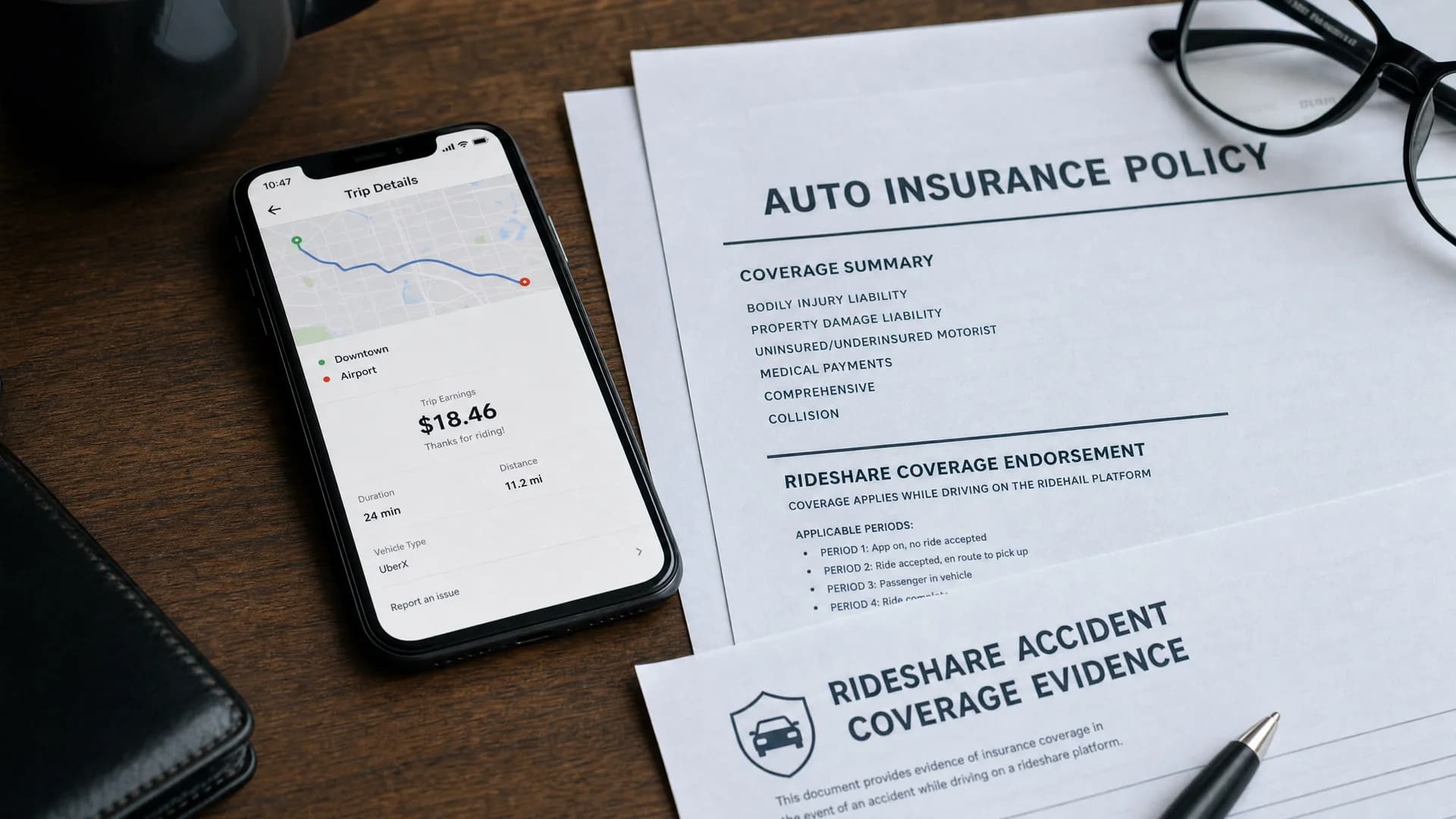
I'll admit I underestimated how aggressive personal auto insurers are about rideshare exclusions until I saw the first denial letter. §627.748(8)(b), Fla. Stat. expressly permits a driver's personal insurer to exclude all coverage when the driver is logged on to the rideshare network. That was not an accident. It was lobbied in. So during Period 1, the driver's personal policy denies the claim, and Uber or Lyft points to the reduced $50k/$100k/$25k limits and calls it a day. For a victim with serious injuries, $50,000 per person often does not touch the medical bills. The answer is to document every insurance layer: the TNC's commercial policy, the driver's personal policy, and your own uninsured/underinsured motorist coverage. UM/UIM on your own auto policy can step in when other coverage falls short, and in Period 1 scenarios, it often does. If you do not carry UM/UIM, that option disappears. I tell every client to check their own policy before they ever need it.
Rideshare Coverage Periods at a Glance
| Factor | Period 1: App On, No Ride Accepted | Period 2/3: Ride Accepted or Passenger In Vehicle |
|---|---|---|
| Bodily Injury Per Person | $50,000 | $1,000,000 primary liability |
| Bodily Injury Per Incident | $100,000 | $1,000,000 primary liability |
| Property Damage | $25,000 | Included in $1M policy |
| Personal Policy Coverage | Likely excluded by insurer | Likely excluded by insurer |
| Coverage Trigger | Driver logged into app | Ride accepted through app |
| PIP 14-Day Rule | Applies, seek care within 14 days | Applies, seek care within 14 days |
What If a Third Driver Caused the Crash?
This situation catches more people off guard than almost anything else in rideshare accident claims. You are a passenger in an Uber. A third driver blows a red light and hits you. Uber and Lyft do not provide first-party insurance coverage for you in that situation. I want to be direct about this because it genuinely surprises most clients: Uber and Lyft removed UM/UIM coverage for passengers several years ago. You are left with the at-fault driver's liability policy and your own UM/UIM coverage if you carry it on a personal vehicle. If that driver is uninsured or underinsured, and you have no UM/UIM of your own, recovering full compensation becomes very difficult. That is exactly why the Florida Department of Financial Services insurance consumer guidance recommends carrying UM/UIM coverage regardless of how you typically travel. South Florida has some of the highest rates of uninsured drivers in the country. That fact matters when you are sitting in someone else's car.
- Get Medical Attention Within 14 Days. Florida's PIP statute §627.736(1)(a) requires initial treatment within 14 days of the crash. Missing that window forfeits your PIP medical benefits entirely. Go to an ER, urgent care, or your primary care physician the same day if possible.
- Screenshot the Rideshare App. Before you close the app, screenshot the trip details showing ride acceptance time, driver name, vehicle info, and the route. This is timestamped evidence of the driver's app status. It takes 10 seconds and it matters.
- Document the Scene. Photograph all vehicle damage, road conditions, traffic signals, and any visible injuries. Get the driver's insurance card, personal auto policy info, and their license. Ask witnesses for contact information before they leave.
- Send a Preservation Letter. Contact an attorney within days, not weeks, so that a formal preservation demand goes to Uber or Lyft before trip data is purged. Once server logs are gone, establishing app status becomes an uphill argument.
- Do Not Give a Recorded Statement. Uber and Lyft's insurers will call quickly and ask for a recorded statement. You are not required to give one to anyone other than your own insurer. Politely decline until you have counsel. What you say in that call can be used to reduce or deny your claim.
Comparative Fault in Rideshare Cases
Since HB 837 took effect on March 24, 2023, Florida applies modified comparative negligence under §768.81(6), Fla. Stat. A plaintiff found more than 50% at fault recovers nothing. In rideshare cases, that rule hits passengers in ways they don't see coming. If you distracted the driver, opened a door into traffic, or grabbed the wheel, an insurer will push your fault percentage past the majority threshold. I've seen adjusters float passenger-fault arguments in cases where the passenger simply asked the driver to take a different route. They do it because it works when the victim has no attorney. The honest answer is that most passengers are at zero or minimal fault. But under Florida's current law, the burden is on you to show that. A comparative fault argument matters just as much when the crash involves a motorcycle accident or a trucking accident where multiple drivers share responsibility.
- Trip Data Preservation. I send a formal written demand to the TNC for all server logs, GPS data, ride-acceptance timestamps, and driver-status records tied to the crash date and time.
- Multi-Layer Insurance Review. I identify all potentially applicable policies: TNC commercial policy, driver's personal policy, your own PIP, MedPay, and UM/UIM coverage on any vehicle you are named on.
- Medical Lien Management. Hospitals and health insurers often place liens on personal injury settlements. Negotiating those liens down is part of maximizing net recovery, not an afterthought.
- Independent Contractor Defense. Under §627.748(9), Fla. Stat., Uber and Lyft classify drivers as independent contractors. That defense limits direct vicarious liability claims against the TNC. But it does not shield them from negligent hiring or retention claims if the driver's record warrants one.
- PIP Coordination. Your own PIP covers up to $10,000 in initial medical bills, but many personal policies contain rideshare carve-outs that reduce it to $5,000 in MedPay. Knowing which applies to your policy from day one shapes the treatment strategy.
How I Approach Uber and Lyft Cases Differently
I have been part of more than 350 cases and recovered over $26 million for injured clients (prior results do not guarantee a similar outcome). That experience taught me what an insurer's file needs to look like before they will discuss serious compensation. Adjusters look for gaps in medical treatment, inconsistencies between the police report and your account, and any evidence of passenger fault. They flag cases where preservation letters were not sent promptly. I build files that close those gaps before the adjuster gets the chance to use them against you. You can also reach me directly about your case. You work directly with me, not a rotating cast of case managers, and my team supports the work behind the scenes. The attorney you hire is the attorney who handles your case. That matters in rideshare cases more than most, because the evidence window is short and the decisions made in the first week carry real weight. I serve clients across Palm Beach, Broward, and Miami-Dade Counties as part of my personal injury practice across Florida. Beyond rideshare cases, I handle car accidents, slip and falls, trip and falls, wrongful death, animal attacks, child injuries, and trucking accidents. Every case gets the same file discipline.
Frequently asked questions
How do Uber/Lyft accident claims differ from regular car accident claims?
What is the statute of limitations for an Uber or Lyft accident claim?
Does the $1 million Uber/Lyft policy apply if I was hit by their driver?
What happens if a third driver caused the rideshare crash I was injured in?
What is the PIP treatment deadline after an Uber or Lyft crash in Florida?
Can I sue Uber or Lyft directly for my injuries in Florida?
Ready to get started?
Reach out today for a fast, no-pressure quote.
This page is for general informational purposes and is not professional, legal, or medical advice. Sean Goldstein can advise on your specific situation, contact us for a consultation. Licensed: FL Bar #1018013.